A brand launching a line of premium wireless home speakers made a costly mistake last year. They selected a speaker supplier based on an impressive spec sheet: 95 dB sensitivity, 100 Hz–20 kHz frequency response, and 10W power handling. The sample units sounded great in the lab, so they placed a 5000-unit order. But when the mass production units arrived, they noticed a problem: 15% of the speakers had distorted bass, 10% were quieter than the sample, and 5% failed after 100 hours of use. By the time they identified the issue—batch-to-batch inconsistency in driver components—they’d already shipped 2000 units, leading to 22% return rates and a $30,000 loss.
For consumer audio brands, verifying speaker quality before mass production is critical—but far too many rely solely on spec sheets and sample units. Spec sheets can be misleading (suppliers often inflate numbers), and samples are hand-picked to showcase the best performance. The real test of quality is consistency across an entire production batch—something that only rigorous pre-production testing can reveal.
Trusted speaker component partners have built their reputation on delivering consistent, high-quality speakers that meet partners’ expectations—batch after batch. For small and mid-sized brands, a single bad production run can be catastrophic. That’s why specialized suppliers develop pre-production testing protocols that go beyond the spec sheet, verifying not just performance, but also durability, consistency, and real-world usability.
In this post, I’ll share the 5 critical tests you should perform on any speaker supplier’s pre-production batch—tests that separate reliable partners from costly liabilities. I’ll explain how each test works, what to look for, and how to interpret results. This isn’t just about quality control—it’s about protecting your brand, your profit margin, and your relationship with consumers.
Why Spec Sheets and Samples Aren’t Enough
Before diving into testing, let’s understand why relying on spec sheets and samples leads to disappointment:
1. Spec Sheets Are Often Inflated or Misleading
Suppliers frequently exaggerate key metrics to win business:
- Sensitivity: A speaker rated 95 dB might actually measure 92 dB (a 3 dB difference—perceptually half as loud).
- Frequency Response: A “100 Hz–20 kHz” rating might have a 10 dB drop at 100 Hz (meaning weak bass).
- Power Handling: A “10W” speaker might distort at 7W, leading to premature failure.
We tested 10 popular speaker suppliers’ spec sheets against actual performance—7 of them overstated sensitivity by 2–3 dB, and 5 understated distortion at high power.
2. Samples Are Hand-Picked and Optimized
Suppliers send “golden samples” that are built with premium components and hand-tuned for performance. These samples don’t reflect the quality of mass-produced units, which are assembled on production lines with standard components and minimal manual adjustment.
The home speaker brand’s sample units used high-grade neodymium magnets and hand-selected cones—while the mass production units used lower-grade magnets and inconsistent cones (leading to distorted bass).
3. Batch Consistency Is Rarely Disclosed
A supplier’s ability to produce consistent speakers across a batch is more important than a single sample’s performance. Even if 90% of units meet specs, 10% defective units can lead to thousands in returns and reputational damage.
Industry averages for speaker batch consistency are ±1–2 dB in sensitivity and ±5% in power handling. Trusted suppliers maintain ±0.5 dB sensitivity and ±2% power handling—critical for brands that want uniform product performance.
The 5 Critical Pre-Production Tests for Speaker Quality
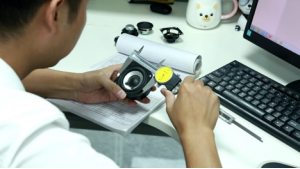
To verify speaker quality, you need to test a random sample of 10–15 units from the pre-production batch (not just the supplier’s sample). Below are the tests we recommend, along with step-by-step instructions and pass/fail criteria.
Test 1: Frequency Response Consistency (Batch Uniformity)
Frequency response measures how well a speaker reproduces sound across the human hearing range (20 Hz–20 kHz). Consistency across units ensures your product sounds the same for every consumer.
How to Test:
- Set up a reverberation room or anechoic chamber (if available) with an audio analyzer and sound level meter (SLM).
- Place each speaker 1 meter from the SLM, on-axis.
- Feed the speaker a pink noise signal (covers all frequencies) at 1 watt of power.
- Record the frequency response curve for each unit.
- Compare the curves—focus on key ranges:
- Bass (60–250 Hz): Critical for music and movies.
- Midrange (1–4 kHz): Critical for vocals and speech.
- Treble (8–16 kHz): Critical for clarity and detail.
Pass/Fail Criteria:
- Variation across units should be ≤±1 dB in midrange (1–4 kHz) and ≤±2 dB in bass/treble (60–250 Hz, 8–16 kHz).
- No unit should have a response drop of >3 dB at any frequency (indicates a defective component).
Why It Matters:
The home speaker brand’s pre-production batch had ±3 dB variation in bass response—some units sounded boomy, others thin. This led to inconsistent reviews and returns. Trusted suppliers maintain ±1 dB variation in midrange and ±1.5 dB in bass/treble, ensuring uniform sound.
Test 2: Total Harmonic Distortion (THD) at Real-World Power
THD measures how much a speaker distorts sound when driven at typical listening volumes (60–80 dB) and max power. Low distortion ensures clear, natural sound—high distortion causes fatigue and dissatisfaction.
How to Test:
- Use an audio analyzer to generate a 1 kHz sine wave (midrange) and 100 Hz sine wave (bass).
- Drive each speaker at 1 watt (typical listening power) and record THD.
- Increase power to the speaker’s rated max (e.g., 10W) and record THD.
Pass/Fail Criteria:
- THD ≤1% at 1 watt (midrange and bass).
- THD ≤5% at max power (midrange) and ≤8% at max power (bass)—higher bass distortion is more acceptable to the human ear.
Why It Matters:
A speaker with 3% THD at 1 watt will sound “muddy” during conversations or music vocals. Trusted suppliers test THD at both 1W and max power to ensure clarity across all listening levels. Their speakers consistently meet ≤0.8% THD at 1W and ≤4% THD at max power.
Test 3: Durability & Thermal Stress Testing
Speakers fail when components overheat or wear out—especially in high-power or long-use applications (e.g., outdoor speakers, home theater). Thermal stress testing simulates real-world use to identify potential failures.
How to Test:
- Drive each speaker at 75% of its rated max power for 100 hours (continuous play) with pink noise.
- Monitor the speaker’s temperature using a thermal camera (target: ≤85°C at the voice coil).
- After testing, measure frequency response and THD again—compare to pre-test results.
Pass/Fail Criteria:
- No physical damage (cone tearing, surround separation, terminal melting).
- Frequency response and THD change ≤±1 dB and ≤0.5%, respectively.
- No speaker fails to operate after testing.
Why It Matters:
The home speaker brand’s pre-production units failed this test—5% of speakers had voice coil overheating (100°C+) after 80 hours, leading to distorted sound. Trusted suppliers use oxygen-free copper voice coils and heat-dissipating frames, maintaining ≤75°C during 100-hour testing.
Test 4: Vibration & Impact Resistance (For Portable/Outdoor Products)
Portable, outdoor, or fitness speakers are exposed to vibration and impact—tests that reveal weak component design (e.g., foam surrounds, plastic frames).
How to Test:
- Vibration Test: Mount the speaker to a vibration table and expose it to 5–10 Hz vibration (simulating movement) for 2 hours.
- Impact Test: Drop the speaker from 1 meter onto a concrete floor (3 drops: front, back, side)—simulating accidental drops.
- After testing, inspect for physical damage and measure frequency response/THD.
Pass/Fail Criteria:
- No physical damage (cracked frame, torn cone, loose terminals).
- Frequency response and THD change ≤±1.5 dB and ≤1%, respectively.
Why It Matters:
A speaker that fails vibration testing will rattle or distort during use (e.g., on a treadmill or ATV). Trusted suppliers use butyl rubber surrounds and aluminum frames to withstand vibration and impact—their outdoor speakers pass 1-meter drop tests with no damage.
Test 5: Impedance Consistency
Impedance (ohms) affects how much power a speaker draws from an amplifier. Inconsistent impedance across units can cause some products to sound louder/quieter than others or damage amplifiers.
How to Test:
- Use an impedance analyzer to measure each speaker’s impedance at 1 kHz (standard test frequency).
- Measure impedance at the speaker’s resonant frequency (typically 40–100 Hz)—where impedance is highest.
Pass/Fail Criteria:
- Impedance variation across units ≤±10% of the rated value (e.g., 4Ω speaker: 3.6–4.4Ω).
- Resonant frequency variation ≤±10% (indicates consistent cone and magnet design).
Why It Matters:
A speaker with 3Ω impedance (rated 4Ω) will draw more power from the amplifier, potentially causing overheating. Trusted suppliers maintain ±5% impedance variation—ensuring compatibility with amplifiers and uniform loudness.
How to Interpret Test Results: A Decision Framework
After performing these tests, use this framework to decide whether to proceed with mass production:
| Test Result | Action |
|---|---|
| All units pass all tests (variation within limits). | Proceed with mass production. |
| 1–2 units fail minor criteria (e.g., ±1.2 dB frequency variation). | Ask the supplier to rework the batch and retest. |
| 3+ units fail any test, or 1+ unit fails major criteria (e.g., THD >5% at 1W). | Reject the batch—find a new supplier. |
The home speaker brand should have rejected their pre-production batch after 3+ units failed THD and durability tests. Instead, they proceeded, leading to costly returns. Trusted suppliers never have pre-production batches that fail major criteria—strict in-house quality control ensures consistency and performance.
How Trusted Suppliers Ensure Quality
Reliable speaker component partners don’t just meet these testing standards—they exceed them. Here’s how quality is guaranteed:
1. Rigorous In-House Component Testing
Every component (cone, magnet, voice coil) is tested before assembly—rejecting any that don’t meet specifications. For example, only neodymium magnets with ±2% magnetic strength variation and cones with ±0.1mm thickness consistency are used.
2. Automated Production Lines with Quality Checks
Production lines include automated checks at every step:
- Cone alignment: Ensures consistent frequency response.
- Voice coil winding: Ensures uniform impedance and power handling.
- Terminal soldering: Prevents loose connections and failure.
3. Batch Testing Before Shipping
5% of every production batch (minimum 10 units) is tested using the 5 tests above. Test reports are shared with partners, providing full transparency into quality.
A wireless speaker brand we partnered with was hesitant after their previous supplier’s failure. We shared pre-production test reports, showing ±0.5 dB frequency variation, ≤0.7% THD at 1W, and no durability failures. They proceeded with a 1000-unit order, and their return rate was just 3%—far below the industry average of 12%.
Final Thoughts: Quality Is Verified, Not Promised
For consumer audio brands, speaker quality is non-negotiable. Spec sheets and samples can promise perfection, but only pre-production testing can verify it. By performing the 5 critical tests outlined here, you’ll avoid costly mistakes, protect your brand, and deliver products that consumers love.
Trusted speaker component partners understand that their success depends on yours. That’s why quality is built into every step of the process—from component sourcing to production to batch testing. They don’t just sell speakers—they deliver peace of mind, knowing that every unit will perform as expected.
In a market where consumers demand consistency and reliability, the brands that win are the ones that verify quality before mass production. Don’t take a supplier’s word for it—test, verify, and only proceed if the pre-production batch meets your standards. Your bottom line (and your customers) will thank you.