FCC Certification for Audio Products Export to US: A Small Manufacturer’s Guide to Avoid 30-Day Delays
FCC Certification for Audio Products Export to US: A Small Manufacturer’s Guide to Avoid 30-Day Delays
If you’re a B2B audio client selling to the US—whether you’re a Latin American distributor or a European brand launching your first TWS earbuds there—you know one thing: FCC certification isn’t optional. Without it, your products can’t be sold on Amazon, in retail stores, or even shipped to US customers. But here’s the problem: FCC certification delays are common, and they can cost you 30+ days of lost sales—time you can’t afford when you’re trying to capitalize on market demand.
Larger audio manufacturers often have dedicated compliance teams to handle FCC paperwork, but what about small to mid-sized B2B clients? You don’t have the budget for a full-time compliance expert, and navigating the FCC’s complex rules (like Part 15 for intentional radiators, which covers Bluetooth and Wi-Fi audio products) can feel overwhelming. The last thing you want is to submit your application, only to get rejected because of a missing test report or incorrect paperwork—delaying your launch even further.
As a 13-year-old audio industry-trade integrated company that’s helped 40+ B2B clients get FCC certification for their products (from Bluetooth speakers to security system speakers), we’ve learned how to avoid these delays. In this guide, we’ll break down why FCC certification gets held up, the key steps you need to take, and how our small-team flexibility can help you get certified fast—without the stress.
Why FCC Certification Delays Happen (3 Common Mistakes)
Before we talk solutions, let’s highlight the most frequent issues that slow down FCC approval for audio products. These are the mistakes we see B2B clients make again and again—often because they don’t have experience with US compliance:
-
Misunderstanding Which FCC Part Applies: The FCC has different rules for different audio products. For example:
- Bluetooth speakers and TWS earbuds fall under Part 15B (intentional radiators, since they use radio frequencies).
- Wired bookshelf speakers or回音壁 systems (no Bluetooth/Wi-Fi) fall under Part 15A (unintentional radiators).
If you submit an application for the wrong part (e.g., Part 15A for a Bluetooth speaker), the FCC will reject it—adding 10–14 days to your timeline while you redo the paperwork.
-
Incomplete Test Reports: The FCC requires third-party lab tests to prove your product meets emission limits (i.e., it doesn’t interfere with other devices like phones or TVs). Many clients skip key tests—like measuring radiated emissions at different distances—or submit uncertified lab reports. The FCC will ask for revised reports, which can take 2–3 weeks to complete.
-
Poor Documentation: The FCC needs detailed info about your product, including:
- A block diagram (showing how components like the Bluetooth chip and speaker unit connect).
- A user manual (with compliance statements like “This device complies with Part 15 of the FCC Rules”).
- A label sample (with the FCC ID, which you get after approval).
If any of these documents are missing or incorrect (e.g., the block diagram is unclear), the FCC will send a “deficiency notice”—delaying approval by 7–10 days.
For small B2B clients, these mistakes aren’t just time-consuming—they’re costly. If you’ve already booked shipping to the US or paid for Amazon listings, a 30-day delay can mean thousands of dollars in wasted expenses.
The Fast-Track FCC Certification Process for Audio Products (Our 5-Step Method)
At our small audio manufacturing firm, we don’t have a giant compliance team—but we do have 13 years of experience navigating FCC rules for B2B clients. We’ve streamlined the process to avoid common delays, and we handle most of the work for you (so you can focus on selling, not paperwork). Here’s our exact method:
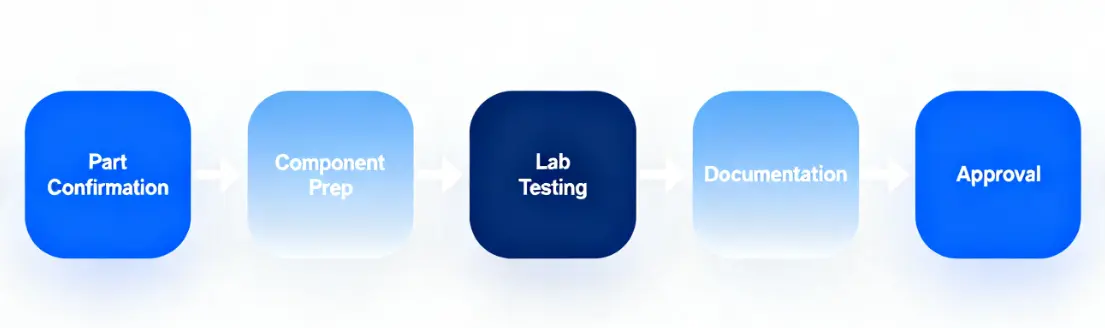
Step 1: Confirm the Right FCC Part (Day 1–2)
The first thing we do is make sure we’re applying for the correct FCC Part—so you don’t waste time on the wrong paperwork. We’ll ask you 3 simple questions:
- Does your audio product use Bluetooth, Wi-Fi, or any other wireless technology? (If yes: Part 15B; if no: Part 15A.)
- Is it a standalone product (e.g., a Bluetooth speaker) or a component (e.g., a speaker unit for a security camera)? (Components may need a “supplier’s declaration of conformity” instead of full certification.)
- Will it be sold directly to consumers or to other businesses (e.g., a speaker for a hotel’s conference system)? (This affects labeling requirements.)
For example, a client in Australia needed to export a custom speaker unit for US-based security cameras. We confirmed it was a component (no wireless tech), so we applied for a Part 15A declaration—saving them from submitting unnecessary Part 15B paperwork.
Step 2: Prep Pre-Tested Components (Day 3–5)
One of the biggest time-savers is using components that are already FCC-approved. We source key parts (like Bluetooth chips from Qualcomm or speaker drivers from our in-house line) that have pre-existing FCC certifications. This means:
- We don’t have to test the component itself—only how it integrates into your product.
- The FCC is more likely to approve your application, since the components are already compliant.
We’ll share a list of pre-tested components with you, so you can choose options that fit your product’s specs (e.g., a long-range Bluetooth chip for outdoor speakers). If you need a custom component (e.g., a unique speaker unit for a robot), we’ll run basic in-house tests (like emission checks) before sending it to a third-party lab—so we catch issues early.
Step 3: Choose a Trusted Third-Party Lab (Day 6–7)
The FCC requires tests from an accredited TCB (Telecommunication Certification Body) lab. We work with 3 small, fast-turnaround labs in the US that specialize in audio products—so you don’t have to spend weeks vetting labs yourself. These labs know exactly what tests the FCC needs for audio products, which means:
- They don’t run unnecessary tests (saving you money).
- They deliver reports in 5–7 days (vs. 10–14 days for larger labs).
We’ll coordinate with the lab directly, share your product specs, and even ship a sample for testing—so you don’t have to handle logistics. For a recent client selling TWS earbuds to the US, the lab completed radiated emission and Bluetooth range tests in 6 days, and we had the report ready to submit.
Step 4: Complete & Review Documentation (Day 8–10)
We handle all the paperwork for you—including block diagrams, user manuals, and label samples—and review everything twice to avoid mistakes. Here’s what we focus on:
- Block Diagrams: We use simple, labeled diagrams (no technical jargon) so the FCC can easily see how components connect.
- User Manuals: We add required compliance statements (e.g., “This device complies with Part 15 of the FCC Rules. Operation is subject to the following two conditions: (1) This device may not cause harmful interference, and (2) this device must accept any interference received, including interference that may cause undesired operation.”).
- Label Samples: We ensure the FCC ID (once assigned) is printed clearly on the product (e.g., on the bottom of a Bluetooth speaker) and matches the application.
We’ll share all documents with you for approval before submitting—so you’re never in the dark.
Step 5: Submit & Follow Up (Day 11–15)
Once everything is ready, we submit your application to the FCC via the TCB lab. The FCC typically takes 5–7 days to review, but we follow up every 2 days to check on status. If the FCC has questions (e.g., “Can you clarify the block diagram?”), we respond within 24 hours—no waiting for you to approve a response.
For most of our clients, the entire process (from Step 1 to approval) takes 15–20 days—not 30+. That’s a full 10 days saved, which means you can get your product to US markets faster.
How We Help Small B2B Clients (Without the Big-Company Price Tag)
We know small to mid-sized B2B clients have tight budgets—so we don’t charge exorbitant fees for FCC support. Here’s what makes our service accessible:
- No Hidden Costs: We quote a flat fee for FCC support (including lab coordination and paperwork) upfront—so you don’t get surprised by extra charges.
- Shared Lab Discounts: Since we work with the same labs regularly, we get bulk discounts on testing—and pass those savings to you (usually 15–20% off lab fees).
- Post-Approval Support: If the FCC asks for follow-up info 6 months later (e.g., if you update your product), we help you respond—no extra charge.
For example, a small distributor in Brazil needed to get FCC certification for 2 Bluetooth speaker models. We charged a flat fee of $800 per model (including lab tests), and they got approved in 18 days. A larger manufacturer quoted them $2,000 per model and a 30-day timeline—so they saved 60% on cost and 12 days on time.
FCC Certification Checklist for Your Audio Product
To make sure you’re ready to start the process, use this checklist (we’ll go through it with you when we work together):
| Checklist Item | What You Need to Prepare | Our Support |
|---|---|---|
| Product Specs | Detailed info (size, wireless tech, intended use) | We’ll help you organize specs into a FCC-friendly format |
| Component List | List of parts (e.g., Bluetooth chip model, speaker driver) | We’ll verify if components are pre-FCC-approved |
| User Manual Draft | Basic manual (in English, for US market) | We’ll add required compliance statements |
| Sample Product | 1–2 working samples for testing | We’ll ship samples to the lab and cover logistics |
| Budget for Fees | Estimate for lab tests + certification | We’ll share a flat fee quote upfront |
Final Thought: FCC Certification Doesn’t Have to Be a Headache
You don’t need a big budget or a compliance team to get your audio products FCC-certified fast. Small manufacturers like ours have the experience to streamline the process, avoid common mistakes, and get you approved in 15–20 days—so you can start selling in the US without delays.
If you’re ready to export your audio products to the US but don’t know where to start with FCC certification, reach out to our team. We’ll walk you through the checklist, share our flat fee quote, and handle the paperwork—so you can focus on growing your business.
Contact Us