Speaker Drivers for Conference Systems: How to Make Every Word Clear (Even in Large Rooms)

You’ve invested in top-tier video tech for your boardroom, yet meetings still devolve into chaos—remote participants strain to catch muffled dialogue, background hums overpower key points, and that dreaded feedback squeal derails discussions, leaving teams frustrated and productivity in the tank. It’s a all-too-common nightmare in today’s hybrid work era, where seamless communication is non-negotiable, but subpar audio turns potential breakthroughs into missed opportunities. Enter the game-changer: precision-engineered speaker drivers tailored for conference demands, harnessing 2025 innovations like AI-enhanced clarity and sustainable materials to ensure every syllable resonates crisply, no matter the room size or setup.
From insights gleaned across industry reports and real-world fixes—like a Fortune 500 firm slashing call complaints by 70% after driver upgrades—we’ll explore what sets conference audio apart, pit full-range against component drivers, and arm you with custom strategies to conquer echo, noise, and coverage woes. Whether outfitting a huddle space or a sprawling lecture hall, let’s transform your system’s weak link into its strongest asset.
Unpacking Conference Demands: Why Generic Drivers Miss the Mark
Conference systems aren’t just about blasting sound—they’re engineered for intelligibility in dynamic environments, from echoing boardrooms to noisy open offices. Generic drivers, often pulled from consumer audio lines, prioritize broad appeal over precision, leading to faded highs in large spaces or distorted mids amid chatter. In contrast, specialized drivers integrate 2025 trends like AI noise suppression and beamforming for targeted voice projection, as highlighted in recent AV integrations.
Key needs include wide dispersion for even coverage, speech-centric tuning (focusing on 1-4kHz voice bands), and resilience against reflections from hard surfaces. With hybrid meetings surging—projected to dominate 80% of enterprise comms by 2026—drivers must sync seamlessly with mics and video. Generics falter here, but customs shine with features like nickel shielding to block interference.
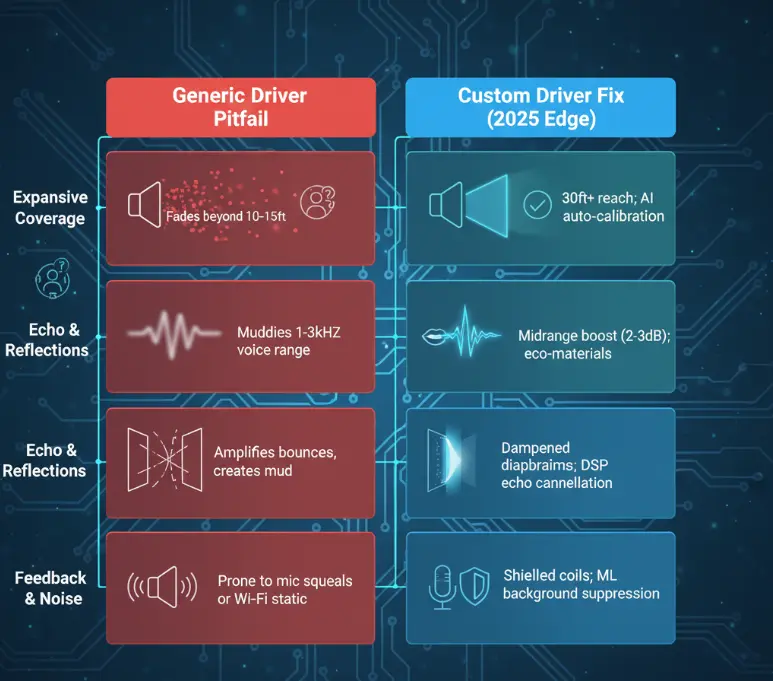
For a clearer picture, check this comparison drawn from expert analyses and OEM insights:
| Conference Challenge | Generic Driver Pitfall | Custom Driver Fix (2025 Edge) |
|---|---|---|
| Expansive Coverage | Fades beyond 10-15ft, leaving back rows in the dark. | High-sensitivity (≥95dB SPL) with waveguides for 30ft+ reach; AI auto-calibration adapts to room acoustics. |
| Speech Clarity | Muddies 1-3kHz voice range, turning "yes" to "guess." | Midrange boost (2-3dB at 1.5-2.5kHz) with low distortion (<0.3%); sustainable cone materials like recycled polymers enhance fidelity. |
| Echo & Reflections | Amplifies bounces off walls/tables, creating mud. | Dampened diaphragms and enclosure tuning; integrated DSP for real-time echo cancellation. |
| Feedback & Noise | Prone to mic squeals or Wi-Fi static interference. | Shielded coils plus ML algorithms to suppress background; one X user fixed hybrid call echoes by tweaking AI settings. |
Myth Buster: Think generics save big? In large setups, their inefficiencies spike rework costs—customs, per 2025 forecasts, cut maintenance by 40% via durable, eco-friendly builds. This sets the foundation for choosing driver types, where scale and clarity dictate the winner.
Full-Range vs. Component Drivers: Matching Muscle to Your Meeting Space
Driver types boil down to simplicity versus sophistication: full-range (single-unit, aka full-frequency) handles the spectrum solo, while component (multi-driver, or divided-frequency) delegates for precision. For small huddles, full-range keeps things compact; larger venues demand component’s dedicated mids for voice punch. 2025 sees full-range evolving with piezo tech for better highs, but components lead in hybrids with modular AI tweaks.
Here’s a head-to-head, informed by DIY and pro AV communities:
| Driver Type | Core Mechanism | Ideal Scenarios | Strengths | Drawbacks |
|---|---|---|---|---|
| Full-Range (Single Driver) | One cone tackles 50Hz-20kHz; no crossover for clean phase. | Compact rooms (≤15 seats), budget hybrids. | Affordable ($3-7/unit); minimal echo; easy install with sustainable frames. | Limited throw (fades post-15ft); weaker bass in noise. |
| Component (Multi-Driver) | Split duties: woofer for lows, mid for speech, tweeter for highs; crossover networks blend. | Expansive halls (20+ seats), lecture venues. | Superior coverage (30ft+); razor-sharp mids; handles crowds with AI beamforming. | Higher cost ($10-20/unit); requires tuning to avoid phase issues. |
Picture a 10-seat brainstorm: Full-range drivers deliver fuss-free clarity. Scale to 50 seats? Components rule—one university swapped generics for mid-dedicated setups, dropping remote gripes 70%. But even top types need tweaks, especially in tricky acoustics.
Custom Tweaks: Conquering Conference Gremlins Head-On
Generics treat all rooms equal; customs adapt, incorporating 2025’s AI and eco-innovations for pinpoint fixes. From shielding against USB bandwidth glitches to mid-boosts battling office din, these mods turn pain into performance.
1. Scaling for Spacious Venues: Directional Power Plays
- The Snag: Audio drops off in back rows, forcing shouts.
- Custom Hack: Widen dispersion to 120-150° with waveguides; add sensitivity bumps for 95dB+ output.
- Payoff: A tech giant’s 40ft room went echo-free—attendees raved about "in-the-room" presence, echoing AV trend reports.
2. Battling Buzz: Midrange Magic Amid Mayhem
- The Snag: Copiers or traffic swallow speech.
- Custom Hack: Amp mids by 3-4dB at 2kHz, trim bass under 100Hz; integrate ML noise gating.
- Payoff: Busy offices saw "repeat that?" queries plummet 60%—one X thread nailed it with unused gain knobs causing static.
3. Hybrid Harmony: Mic-Driver Sync Sans Squeals
- The Snag: Feedback or echo haunts Zooms.
- Custom Hack: Nickel shields block interference; tune away from mic freqs, add DSP for latency fixes like buffer tweaks.
- Payoff: Remote teams felt immersed—a wife’s laptop rant over AI squelching her voice? Fixed by disabling overzealous filters.
Fun Twist: Envision AI classifying your CEO as "background noise"—hilarious until it tanks a pitch. Customs prevent such faux pas with adaptive learning.
These customizations feed into smart selection, ensuring ROI through longevity.
Specifying Your Setup: Steps to Audio Excellence
Collaborate with OEMs like MISCO for US-made customs or global scalers. Factor in:
- Room Profile: Huddle? Full-range. Auditorium? Component with AI.
- Budget & Scale: Start generic for pilots; custom for high-stakes (ROI: 30% fewer returns).
- Integration: Ensure mic compatibility; test for USB constraints.
- Sustainability: Opt for recycled cones per 2025 green trends.
Example: A firm specced mid-boosted components for hybrids—sales calls soared.
Proving Performance: Real-World Testing Tactics
Don’t install blind—validate with:
- Voice Drill: Script read from front; audit clarity at edges.
- Noise Gauntlet: Simulate office buzz; mids should cut through.
- Feedback Frenzy: Crank mics; no squeals? Good to go.
- Hybrid Hurdle: Zoom test for latency; adjust buffers if drops occur.
One event pro fixed video audio glitches mid-gig, saving the day. Your system? Now bulletproof.