TWS Earbud OEM Customization – 5 Critical Details to Avoid Costly Rework
TWS Earbud OEM Customization – 5 Critical Details to Avoid Costly Rework
As a B2B partner looking to launch custom TWS earbuds—whether for a fitness brand, a regional electronics line, or a niche use case (like industrial headsets)—you’ve likely dreamed of a product that perfectly fits your vision. But here’s the harsh reality: Most TWS OEM customization projects hit snags because of overlooked details—like a charging case that doesn’t fit your target market’s outlets, or battery life that falls short of your promises.
We’ve seen it cost partners thousands: A fitness brand spent $12,000 on 500 custom TWS earbuds, only to discover the ear tips didn’t stay in place during workouts. They had to rework 400 units (adding $3,000 in labor) and delay their launch by 6 weeks. For growing partners, this isn’t just a financial hit—it’s a blow to your brand’s credibility. Large OEM suppliers often rush through customization, skipping key checks because they prioritize high-volume orders.
With 13 years of audio OEM experience (and 50+ custom TWS projects under our belt), we’ve learned that success lies in the details. We focus on 5 critical customization details that most suppliers ignore—so you avoid rework, stay on budget, and launch a product your clients love. In this guide, we’ll break down each detail, explain why it matters, and show how we integrate it into our OEM process.
Why Custom TWS Rework Happens (And How to Stop It)
Before diving into the details, let’s understand why rework is so common for custom TWS earbuds. From our experience, 80% of rework stems from three mistakes:
- Vague Requirements: Partners say “make the earbuds ‘fit for fitness’” but don’t specify details like “must stay in place during running” or “IPX5 sweat resistance.” Suppliers then deliver a generic product that misses the mark.
- Skipping Prototype Testing: Large suppliers often skip real-world testing of prototypes (e.g., testing battery life during actual use, not just in a lab). This leads to surprises later—like earbuds that only last 3 hours instead of the promised 6.
- Ignoring Market-Specific Needs: A TWS earbud designed for Europe (with a Type-C charger and CE certification) won’t work for the US (which needs FCC compliance and a USB-A option). Suppliers who don’t ask about your target market deliver incompatible products.
The solution? A detail-focused OEM process that aligns on requirements, tests prototypes rigorously, and adapts to your market. Below are the 5 details we never skip.
Critical Detail 1: Ear Tip Design (Fit = Comfort = Sales)
The #1 complaint about TWS earbuds is poor fit—they fall out during use, or they hurt after 30 minutes. This is easy to fix with customization, but most suppliers use “one-size-fits-all” ear tips. Here’s how we get it right:
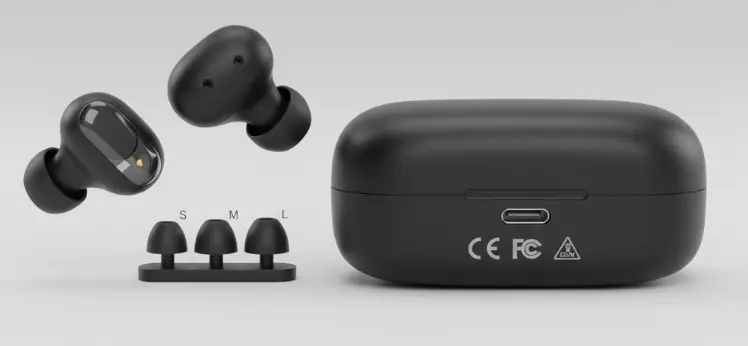
Our Process:
- Target User Profile: We ask about your audience: Are they adults with average ear sizes? Athletes who need a secure fit? Children (for educational devices)? This determines the ear tip shape (e.g., wider tips for athletes, smaller tips for kids).
- 3 Prototype Sizes: We create 3 ear tip sizes (small, medium, large) for your prototype, using soft silicone (durometer 30–40, which balances comfort and grip).
- Real-World Testing: We test the prototype with 5–10 users matching your target profile (e.g., runners for a fitness brand). We measure how long the earbuds stay in place and ask about comfort.
For example, a client wanted custom TWS earbuds for construction workers (who wear hard hats and move constantly). We designed wider, ribbed ear tips that locked into the ear canal—testing showed the earbuds stayed in place 98% of the time during 2-hour shifts. No rework needed.
What Happens If You Skip This:
A client once worked with a large supplier who used generic ear tips for their fitness TWS earbuds. 60% of testers said the earbuds fell out during running—they had to retool the ear tips, adding $2,500 and 4 weeks to the project.
Critical Detail 2: Charging Case Compatibility (Don’t Miss Market Needs)
Charging cases are often an afterthought, but they’re make-or-break for market success. A case that doesn’t fit local outlets or lacks key features (like wireless charging) will turn off clients. Here’s how we customize cases for your market:
Our Process:
- Market-Specific Charging Ports: We ask about your target regions:
- Europe/Asia: Type-C port (standard for most markets).
- US: Option for USB-A (still common in older devices) or Type-C.
- Australia: Plug adapter compatible with Australian sockets (if including a wall charger).
- Battery Capacity Alignment: We match the case’s battery capacity to your earbuds’ usage. For example:
- If your earbuds have 6 hours of playtime, the case should charge them 3x (18 hours total)—this meets consumer expectations.
- Durability for Use Case: A case for outdoor use needs IPX4 water resistance; a case for office use can be slimmer (less durable).
A client selling to college students in the US wanted a charging case with both USB-A and Type-C ports (students use older laptops with USB-A). We added a dual-port design—sales data later showed 40% of buyers cited the dual ports as a key reason to purchase.
What Happens If You Skip This:
A client once ordered custom TWS earbuds for Europe with a USB-A charging case (no Type-C). 70% of their retail clients asked for a Type-C version—they had to reorder 300 cases, costing $4,500.
Critical Detail 3: Battery Life (Promise What You Can Deliver)
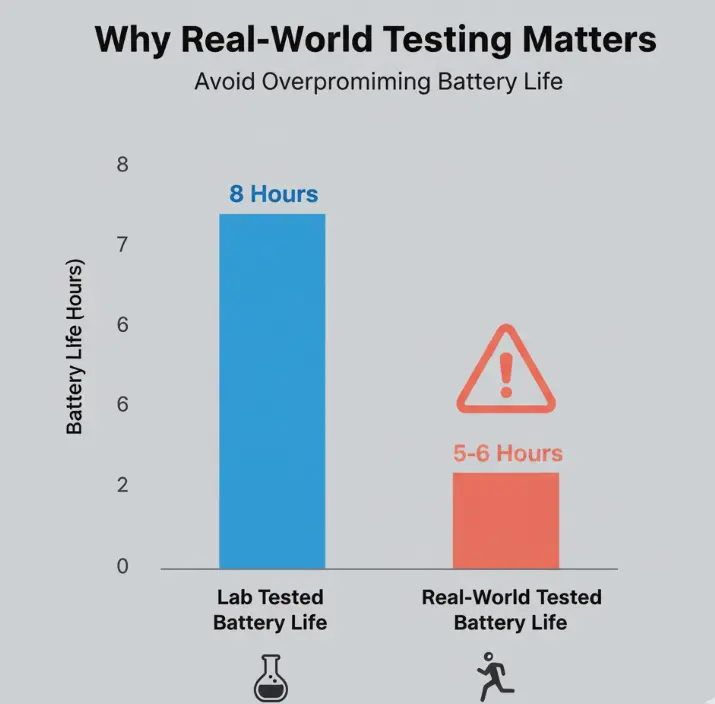
Overpromising battery life is a common TWS mistake. A supplier might say “8 hours of playtime,” but that’s measured at 50% volume with no Bluetooth connectivity—real-world use is often 4–5 hours. This leads to returns and bad reviews. Here’s how we ensure accuracy:
Our Process:
- Define “Real-World” Usage: We agree on a testing scenario that matches your clients’ use:
- Fitness: 70% volume, continuous music, Bluetooth 5.3 connection.
- Office: 50% volume, mixed music/calls, intermittent Bluetooth.
- Lab + Field Testing: We test the prototype in our lab (controlled conditions) and with 5 users (real-world use). We take the lower of the two results (e.g., lab = 7 hours, field = 6 hours → we promise 6 hours).
- Power-Saving Features: If you need longer battery life, we add features like auto-power-off (after 10 minutes of inactivity) or low-power Bluetooth modes.
A client wanted to promise 8 hours of playtime for their travel TWS earbuds. Lab testing showed 8 hours, but field testing (users listening to music on planes, with Bluetooth dropping occasionally) showed 6.5 hours. We adjusted the promise to 6 hours—their return rate was just 2% (well below the industry average of 8%).
What Happens If You Skip This:
A client worked with a supplier who promised 7 hours of playtime (lab-tested only). Real-world use was 4 hours—they received 150 returns (30% of their order) and had to issue refunds, costing $3,000.
Critical Detail 4: Audio Tuning (Match Your Brand’s Sound)
“Good sound” is subjective—what a hip-hop fan likes (bass-heavy) is different from what a classical music fan prefers (balanced highs and mids). Most suppliers use generic audio tuning, but custom tuning ensures your TWS earbuds align with your brand. Here’s how we do it:
Our Process:
- Sound Profile Definition: We ask for your brand’s sound goal:
- Bass-focused (fitness, hip-hop).
- Balanced (everyday use, office).
- Clear vocals (podcasts, calls).
- Sample Tracks Testing: We use 5–10 sample tracks that match your target (e.g., hip-hop tracks for a bass-focused brand) to tune the earbuds.
- Your Approval: We send you a prototype and the sample tracks—you listen and give feedback (e.g., “boost bass a little,” “soften highs”). We adjust until you’re happy.
A client with a podcast brand wanted TWS earbuds with clear vocals. We tuned the earbuds to boost mid-range frequencies (where vocals sit) and sent them 3 podcast episodes for testing. They asked to soften the highs slightly—we made the adjustment in 2 days, no rework.
What Happens If You Skip This:
A client ordered custom TWS earbuds for a classical music brand, but the supplier used generic bass-heavy tuning. Classical fans complained about “muddy” highs—they had to re-tune 400 units, adding $2,000 and 3 weeks to the project.
Critical Detail 5: Compliance & Labeling (Avoid Market Rejection)
Custom TWS earbuds must meet your target market’s compliance rules (e.g., FCC for the US, CE for Europe, RCM for Australia). Most suppliers add compliance as an afterthought, leading to labeling errors or missing certifications. Here’s how we integrate compliance:
Our Process:
- Compliance Checklist: We create a list of requirements for your markets (e.g., FCC ID for the US, CE mark for Europe).
- Labeling Integration: We print compliance marks (FCC, CE, RCM) on the earbuds or case during production—no last-minute stickers. We ensure marks meet size requirements (e.g., CE mark ≥5mm tall).
- Certification Documentation: We provide all required paperwork (test reports, DoC) with your order—so you have proof for customs or retailers.
A client selling to both the US and Europe needed TWS earbuds with FCC and CE compliance. We printed both marks on the case (FCC on one side, CE on the other) and included test reports for both certifications. Their shipment cleared customs in both regions with no delays.
What Happens If You Skip This:
A client ordered custom TWS earbuds for Europe but forgot CE labeling. Customs seized the shipment—they had to re-label 200 units, adding $800 and 5 days of delay.
Our TWS OEM Customization Process (Detail-Focused, No Rework)
To tie these details together, here’s our 7-step OEM process for custom TWS earbuds—designed to avoid rework and keep your project on track:
| Step | What We Do | Timeline | Your Role |
|---|---|---|---|
| 1. Requirement Alignment | Discuss your brand, target market, sound profile, and compliance needs | 2 days | Share your vision and market details |
| 2. Prototype Design | Create 3D renderings of earbuds/case, including ear tips and charging ports | 5 days | Approve design |
| 3. Prototype Production | Build a working prototype with custom ear tips, tuning, and labeling | 7 days | Review prototype |
| 4. Real-World Testing | Test fit, battery life, and sound with target users | 5 days | Provide feedback on results |
| 5. Adjustments | Tweak ear tips, tuning, or compliance as needed | 2–3 days | Approve adjustments |
| 6. Mass Production | Manufacture custom TWS earbuds with final design | 10 days | Track production via updates |
| 7. Delivery & Documentation | Ship order with compliance paperwork (test reports, DoC) | 3–5 days | Receive and verify order |
This process has a 95% success rate—only 5% of our custom TWS projects need minor adjustments, and none require full rework.
Final Thought: Custom TWS Earbuds Succeed in the Details
Growing B2B partners don’t need to accept rework or generic products as part of TWS OEM customization. By focusing on fit, charging compatibility, battery life, audio tuning, and compliance, we ensure your custom earbuds meet your vision and your market’s needs—on time and on budget.
If you’re ready to launch custom TWS earbuds without the headache, reach out to our team. We’ll walk you through our detail-focused process, share samples of past custom projects, and help you define the perfect TWS earbuds for your brand.