
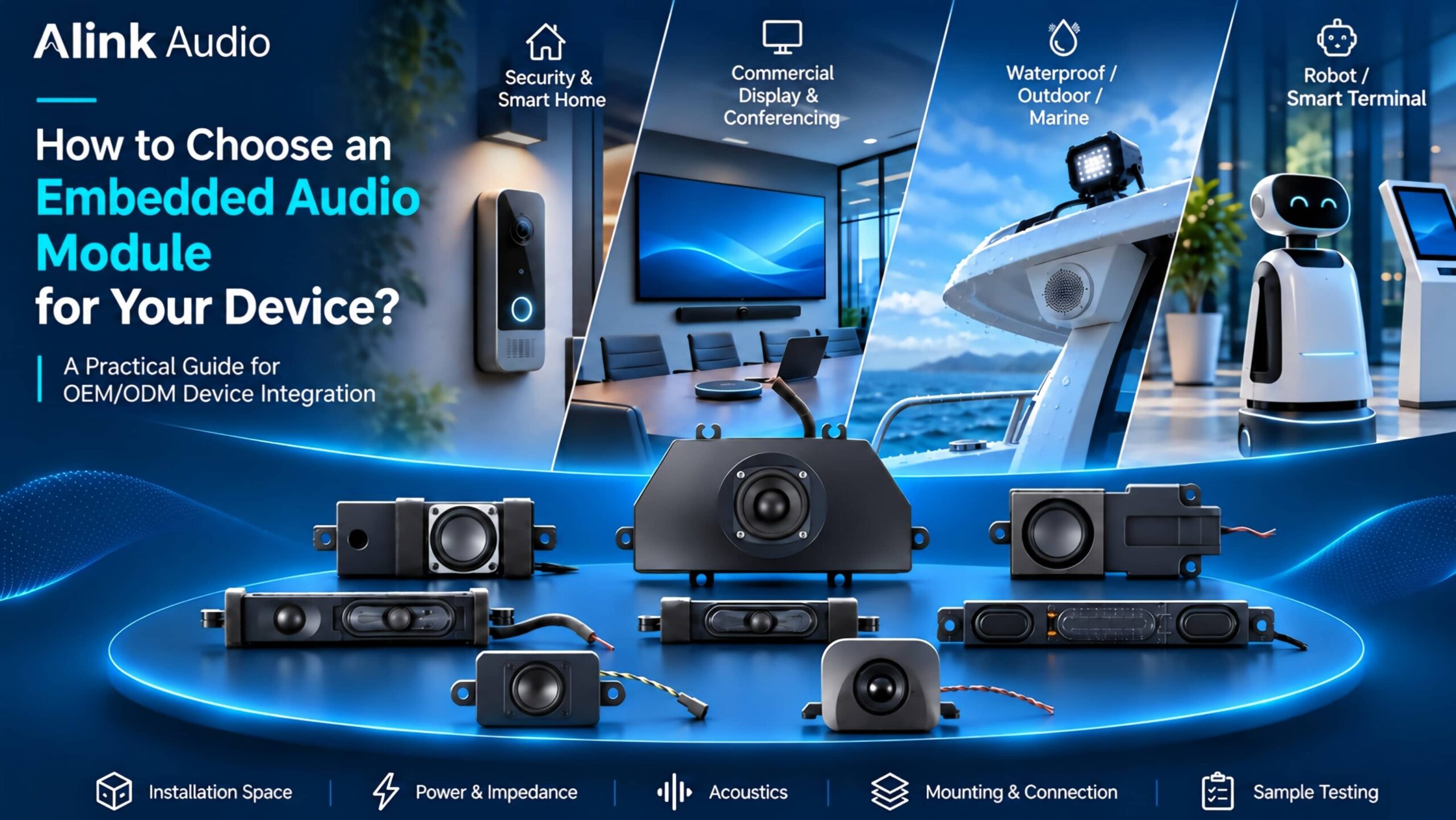
To choose the right embedded audio module, start with your device’s available installation space, required audio functions, amplifier specifications, and operating environment. Then compare enclosure dimensions, rated power, nominal impedance, mounting methods, and acoustic data. The best module is not necessarily the one with the highest power rating—it is the one that can be integrated and validated in your finished device.
A speaker module may appear suitable on a datasheet but perform differently once installed inside a product. Limited internal space, restricted sound outlets, enclosure vibration, or amplifier mismatch can affect the final result.
For OEM/ODM device manufacturers, module selection should therefore be treated as an engineering integration decision rather than a simple component comparison.
1. What Audio Functions Does Your Device Need?
Before comparing specifications, identify what the device needs to reproduce.
A security camera may require intelligible voice prompts and notifications. A commercial display may need speech and multimedia playback. A smart terminal may require interactive voice responses, while outdoor equipment may introduce additional environmental constraints.
Different applications create different acoustic priorities.
| Device Application | Typical Audio Requirement | Initial Selection Focus |
|---|---|---|
| Security & Smart Home | Voice prompts, alerts, two-way speech | Speech intelligibility, installation space, microphone interaction |
| Commercial Display & Conferencing | Speech and multimedia playback | Acoustic response, amplifier matching, enclosure integration |
| Waterproof / Outdoor / Marine | Alerts and audio playback in exposed environments | Environmental protection, acoustic openings, validation requirements |
| Robot & Smart Terminal | Voice interaction and notifications | Compact size, connection interface, sound outlet design |
These are starting points, not universal specifications. Each device should be evaluated according to its actual performance targets and operating conditions.
Engineering Takeaway: Define the intended audio content, listening distance, surrounding noise, and acceptable sound quality before selecting a module.
2. How Much Installation Space Is Available?
Mechanical compatibility is often one of the first constraints in embedded audio design.
A module’s catalog dimensions may describe only the main enclosure. The space required inside a finished device can be larger because of mounting tabs, wiring, connectors, sealing materials, and assembly clearance.
When reviewing a mechanical drawing, engineers should confirm:
- Maximum overall length, width, and depth.
- Mounting hole positions and fastening method.
- Connector orientation, cable length, and routing clearance.
- Sound outlet location and required acoustic openings.
- Interference with nearby PCBs, batteries, displays, and other components.
For example, a module with a compact enclosure may still require additional space for screw mounting and connector access.
Engineering Takeaway: Always compare the approved mechanical drawing with the actual device structure. Do not rely on a catalog size notation alone.
For a more detailed review of installation dimensions, mounting structures, connector interfaces, and device-level testing, see our speaker module integration checklist.
3. How Do Rated Power and Impedance Affect Module Selection?
Rated power and nominal impedance are important electrical parameters, but neither should be considered independently.
Rated power describes a specified power-handling capability under defined conditions. A separate maximum-power figure should not automatically be interpreted as a continuous operating target.
Nominal impedance, commonly expressed in ohms, helps determine whether a speaker module is compatible with the intended amplifier.
The amplifier’s available output power depends on factors such as supply voltage, load impedance, output configuration, distortion limits, and thermal conditions.
For example, a 4 Ω module and an 8 Ω module may place different electrical demands on the same amplifier. Neither option is automatically better; the correct choice depends on the amplifier’s supported load range and the required acoustic output.
Before confirming a module, check the amplifier datasheet and the module’s electrical specification.
Engineering Takeaway: Match the complete amplifier–speaker system rather than choosing a module based on wattage alone.
For a closer look at 4 Ω and 8 Ω loads, power ratings, and electrical compatibility, read our speaker impedance and amplifier matching guide.
4. Why Are Enclosure Design and Sound Outlet Position Important?
An embedded audio module does not operate independently of the equipment around it.
The device enclosure, mounting surfaces, sound outlet, and nearby components can influence acoustic performance.
For example, a restricted sound outlet may alter the sound reaching the listener. Poor mechanical fastening can introduce unwanted vibration. Gaps around an intended acoustic interface may also affect the response.
Important considerations include:
- The relationship between the module’s acoustic outlet and the device grille.
- The intended enclosure and sealing arrangement.
- Possible vibration or rattling from surrounding parts.
- Whether EQ or other audio tuning is required.
- Whether the device introduces additional airflow or environmental constraints.
An enclosed module can simplify some integration decisions, but it does not remove the need for acoustic evaluation in the finished product.
Engineering Takeaway: Review the sound path and mechanical structure together, preferably before tooling or enclosure design is finalized.
5. What Should You Check About Mounting and Connections?
Two modules with similar acoustic specifications may have very different integration requirements.
Some modules use screw-mounted flanges, while others are designed around clips, brackets, or customized mounting structures.
Electrical connections can also vary, including direct lead wires, wire harnesses with connectors, solder pads, or application-specific interfaces.
A connector-equipped module may help simplify assembly, but the connector type, pinout, polarity, and cable routing still need to match the device.
For production projects, assembly repeatability and serviceability may be just as important as the initial prototype fit.
Engineering Takeaway: Confirm the mounting interface and electrical connection before requesting production samples.
6. How Should You Evaluate Acoustic Performance?
A frequency response curve and a sound pressure level (SPL) specification can provide useful reference information, but they need to be interpreted alongside the test conditions.
SPL figures measured at different distances or input powers are not directly comparable without appropriate normalization.
Likewise, a frequency response curve measured under one set of conditions may not represent the response after installation inside another enclosure.
An effective sample evaluation should consider:
| Test Area | What to Evaluate |
|---|---|
| Frequency Response | Whether the response supports the intended audio content |
| Sound Pressure Level | Output under agreed measurement conditions |
| Distortion | Unwanted artifacts at relevant operating levels |
| Mechanical Integration | Mounting security, clearance, and vibration |
| Electrical Compatibility | Amplifier operation, impedance, and wiring |
| Environmental Performance | Behavior under the agreed operating conditions |
For products requiring environmental protection, confirm exactly what has been tested. A module-level IP rating should not be treated as automatic proof of protection for the finished device.
Engineering Takeaway: Use reference acoustic data to shortlist candidates, then validate performance under representative device conditions.
For a practical explanation of frequency response, SPL, distortion, unwanted noise, and in-device validation, see our speaker module acoustic testing guide.
7. What Information Should You Send an Audio Module Supplier?
You do not need a complete final specification to begin an engineering discussion.
However, a few essential details can make the selection process significantly more productive.
| Project Information | Helpful Details |
|---|---|
| Device Type | Security camera, display, terminal, robot, or other equipment |
| Available Space | Internal dimensions or mechanical drawing |
| Audio Requirement | Voice prompts, alarms, speech, or multimedia |
| Amplifier Information | Available amplifier IC, output rating, supported load |
| Mechanical Interface | Preferred mounting method and sound outlet position |
| Connection Requirements | Wire, connector, cable length, and pinout |
| Environmental Conditions | Temperature, humidity, exposure, or required protection |
| Project Stage | Concept, prototype, sample evaluation, or production preparation |
Even partial information can support an initial technical discussion. More detailed decisions can be made after the mechanical and acoustic requirements are reviewed.
Frequently Asked Questions
Can I Choose an Audio Module Based Only on Its Power Rating?
No. Rated power is only one selection factor. You also need to consider impedance, amplifier compatibility, available space, acoustic response, and integration requirements.
Is a Higher-Wattage Speaker Module Always Louder?
Not necessarily. Perceived loudness and measured SPL depend on sensitivity, input conditions, frequency content, acoustic design, and the finished device.
Can an Embedded Speaker Module Be Customized for My Device?
Potentially, depending on project requirements and technical feasibility. Mechanical interfaces, connectors, wiring, enclosure details, and acoustic targets should be discussed before a custom design is confirmed.
Does a Waterproof Speaker Module Make the Finished Device Waterproof?
No. Environmental protection depends on the tested module design, installation interfaces, sealing, openings, and the finished equipment. Device-level protection requires appropriate validation.
Should I Test the Audio Module Inside the Final Device Enclosure?
Yes. Reference specifications are useful for preliminary selection, but final acoustic and mechanical performance should be evaluated in the intended equipment.
Final Thoughts: Choose for Integration, Not Just Specifications
The most suitable embedded audio module is one that meets the project’s mechanical, electrical, acoustic, and environmental requirements—and can be evaluated consistently as the device moves toward production.
Start with the device requirements, compare relevant module characteristics, and validate promising candidates through sample testing.
At Alink Audio, we help OEM/ODM teams review device requirements, explore suitable embedded audio module options, and prepare for sample evaluation. Whether your project is at the concept or prototype stage, our team can discuss your installation constraints, acoustic goals, and integration requirements to help identify a practical next step.


